
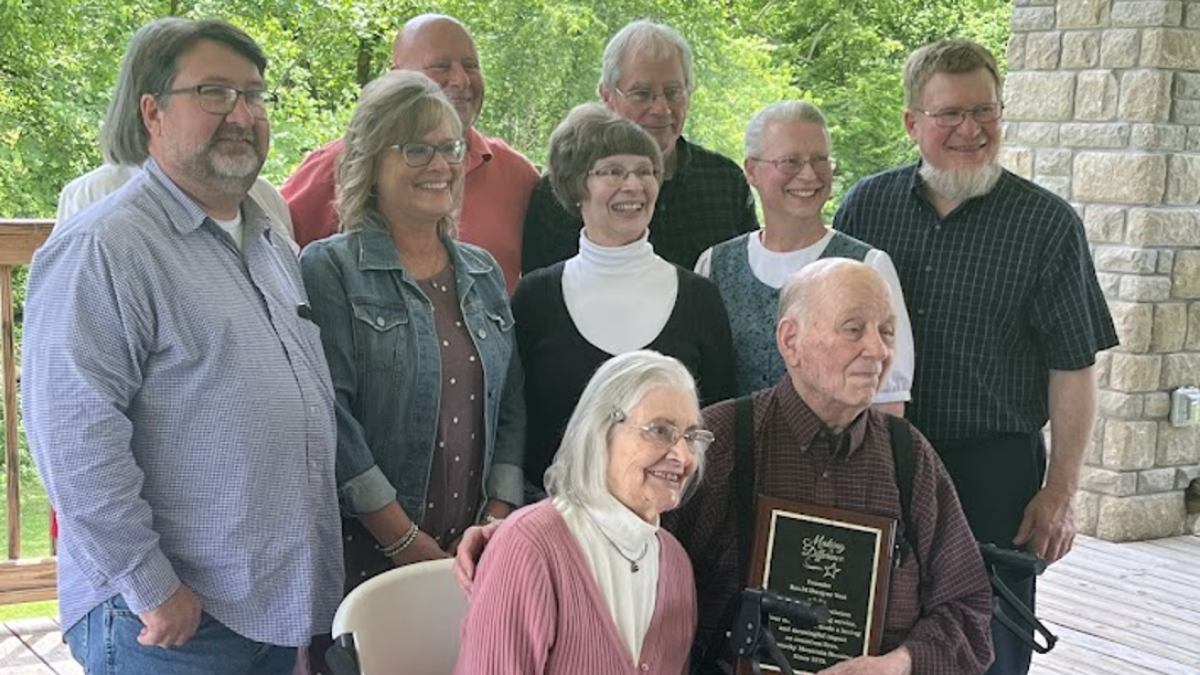
Celebrating Rev. Dwayne Yost’s Legacy and Impact on Affordable Housing

By Traviss Witt
On May 15th, family and friends from across the country came together to celebrate Reverend Dwayne Yost and the work that grew from a simple but radical idea: that everyone deserves a safe, decent place to live.
That idea became Kentucky Mountain Housing. In the beginning, it wasn’t framed as a scalable model. There were no master plans or KPIs to track progress. There were just families in Clay and Jackson Counties living in conditions that needed to change, and small groups of dedicated people willing to do something about it. They built one home, then another, and worked with anyone in the community who cared enough to help. Since its founding, KMH has built more than 900 homes across eastern Kentucky. That outcome feels almost impossible when you look at the humble beginnings.
Rev. Yost first came to Kentucky in 1960 as a minister with the Church of the Brethren. During his time here, he and others began to see up close the housing conditions many families were facing. Conditions that too often were accepted because there were very few alternatives. For Yost, that wasn’t something to observe from a distance. It was something to act on.
In 1972, he made the decision to stay in Kentucky and focus his work on securing decent, affordable housing for families in Clay and Jackson Counties. What followed was not the launch of a single program, but the beginning of a 50+ year collaboration bringing together faith communities, partners like Red Bird Mission, and organizations such as the Daniel Boone Development Council. Through those relationships, Kentucky Mountain Housing was formed and ultimately resulted in KMH being one of the seven non-profit and church groups that formed the original Federation of Appalachian Housing Enterprises, or Fahe.
Construction on the first home began in 1973. One was completed in 1974. Three more followed that same year. By 1975, eight homes had been built. From there, with proof of concept in place, it continued to grow.
What set KMH apart early on wasn’t just that it built homes, but how it went about building those homes. Under Rev. Yost’s leadership, the organization created a revolving loan fund to make homeownership possible for families who could not access traditional financing. While that is relatively common today, at the time it was a revolutionary idea. Partnerships with churches, nonprofits, and public agencies created not just funding streams, but a shared sense of ownership in the work. Training programs created jobs alongside housing. It was never just people coming together around a single project; it was always people coming together around a common purpose.
The impact of that work was recognized all along the way. In 1982, Rev. Yost received the Winthrop Rockefeller Award for Distinguished Rural Service, honoring his commitment to improving the lives of others. By 1997, Kentucky Mountain Housing had become one of the most prolific nonprofit builders of new homes in the nation. At KMH’s 25th anniversary, it was said plainly: Mr. Yost was widely regarded as the grandfather of nonprofit housing corporations.
On May 15th, 2026, none of that was the focus. When Rev. Yost was asked to speak in a room full of people gathered to recognize him, he did what was true to character: he chose a different path. He moved across the room, calling out people by name and acknowledging the importance of their contributions. The room itself reflected the full arc of the story, with current KMH staff alongside people who had been on the payroll in 1973. He reminded everyone present that whatever had been accomplished was built together, piece by piece, by many hands over many years.
The story of Kentucky Mountain Housing, and in many ways the story of Fahe, has always been about more than housing. It began with one person who saw a need and chose to act. It grew because others were welcomed in, trusted, and recognized as vital to the work. The homes are real. The numbers matter. But the lasting strength of Dwayne’s servant leadership lies in how it was built: through relationships, shared effort, and the belief that progress belongs to everyone.
That’s how an idea becomes 900 homes. On May 15th, in a room full of people who helped carry that work forward, that was the part you could feel most clearly. Not just what had been done, but how it was done, and why it will carry on.